Background
The 2011 Formula One season saw Pirelli as the sole F1 tyre manufacturer following the departure of Bridgestone at the end of the 2010 season. Their remit was to make the tyres give us (the fans) the kind of exciting races exemplified by the 2010 Canadian Grand Prix.
Whereas in previous seasons Bridgestone tyres would keep going, albeit degrading gracefully, Pirelli have constructed tyres which will essentially "fall off a cliff". In other words, there's only so much life in the tyre, and once it's "gone" that's it. This makes it increasingly important for the drivers to manage their tyres across a race stint, being careful not to take too much life out of them too early.
Pirelli have nine different types of tyres for the season: seven dry compounds, and two wet. Under the sport's rules, only three compounds of slick tyre will be used for each race and the drivers are obliged to run at least two of them (including one mandated by Pirelli) during the course of the race (unless the race is declared wet). If a driver fails to use these compounds during the race then a 30 second penalty will be applied to his race time.
Tyre Allotment
Each car has a specific allocation of tyres to last the weekend: 11 sets of dry-weather tyres available to each driver per race weekend. Drivers will receive three sets (two prime, one option) to use in P1 and P2 and must return one set after each session. A further eight sets will then be at their disposal for the rest of the weekend, although one set of each specification must be handed back before qualifying. (At certain events, teams may be given an extra set of primes for use in P1 and P2, or an additional specification of dry-weather tyre - again for P1 and P2 only - for evaluation purposes. Teams will be given at least a weeks notice when either of these scenarios is to occur.)
Strategy
Of course the strategy in real-life is a bit more complicated than "what tyres are you running". In truth it will be a combination of the following things (plus some others):
- Tyre choice.
- Fuel load.
- The cars run substantially quicker on a lower fuel load, this also impacts the tyre wear.
- Track surface.
- High abrasion circuits wear out the tyres more quickly.
- Track position.
- Running behind another car on the track affects things.
- Weather.
- Track temperature.
- Cold weather imacts the ability to warm up the tyre to its operating temperature affecting tyre wearing.
These factors and other data vectors are what this site aims to use in its prediction modelling. Will it work? Who knows! What it will be is an interesting aside...
Dry Tyres
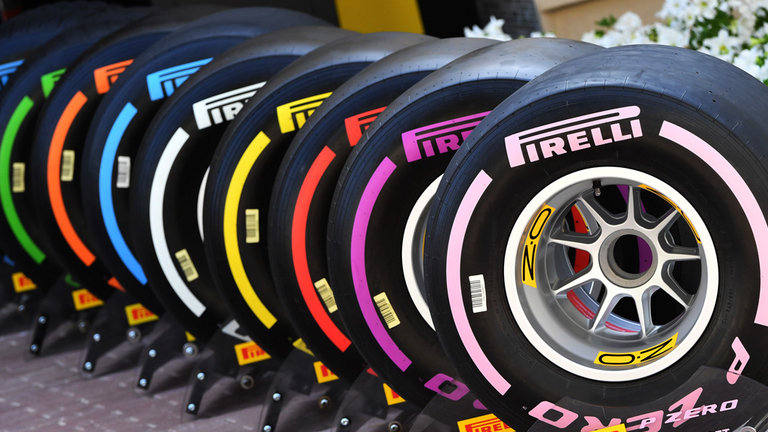
| Colour | Type | |
|---|---|---|
| Pink | Hyper soft | |
| Purple | Ultra soft | |
| Red | Super soft | |
| Yellow | Soft | |
| White | Medium | |
| Light Blue | Hard | |
| Orange | Super Hard |
Wet Tyres
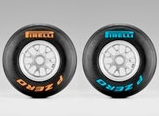
| Colour | Type | |
|---|---|---|
| Green | Intermediate | |
| Blue | Full Wet |